I study the politics of artificial intelligence and emerging technologies. Specifically, my research examines how AI policies emerge and diffuse globally, how citizens respond to technological change, and how Big Tech companies are regulated. I am a Postdoctoral Fellow at the Data Science and AI Institute at Johns Hopkins University.

I received my Ph.D. in Government from the University of Texas at Austin, an M.A. in International Relations from New York University and a B.A. in Journalism from Northeastern University. I was a Postdoctoral Fellow at the Niehaus Center for Globalization and Governance at Princeton University from 2025-2026.

Huimin is pronounced as h-way-min.
Featured Publications


Behavioral nudges in social media ads show limited ability to encourage COVID-19 vaccination across countries.
PNAS Nexus 2024, with Olgahan Çat, Jiseon Chang, Roman Hlatky, Daniel Nielson

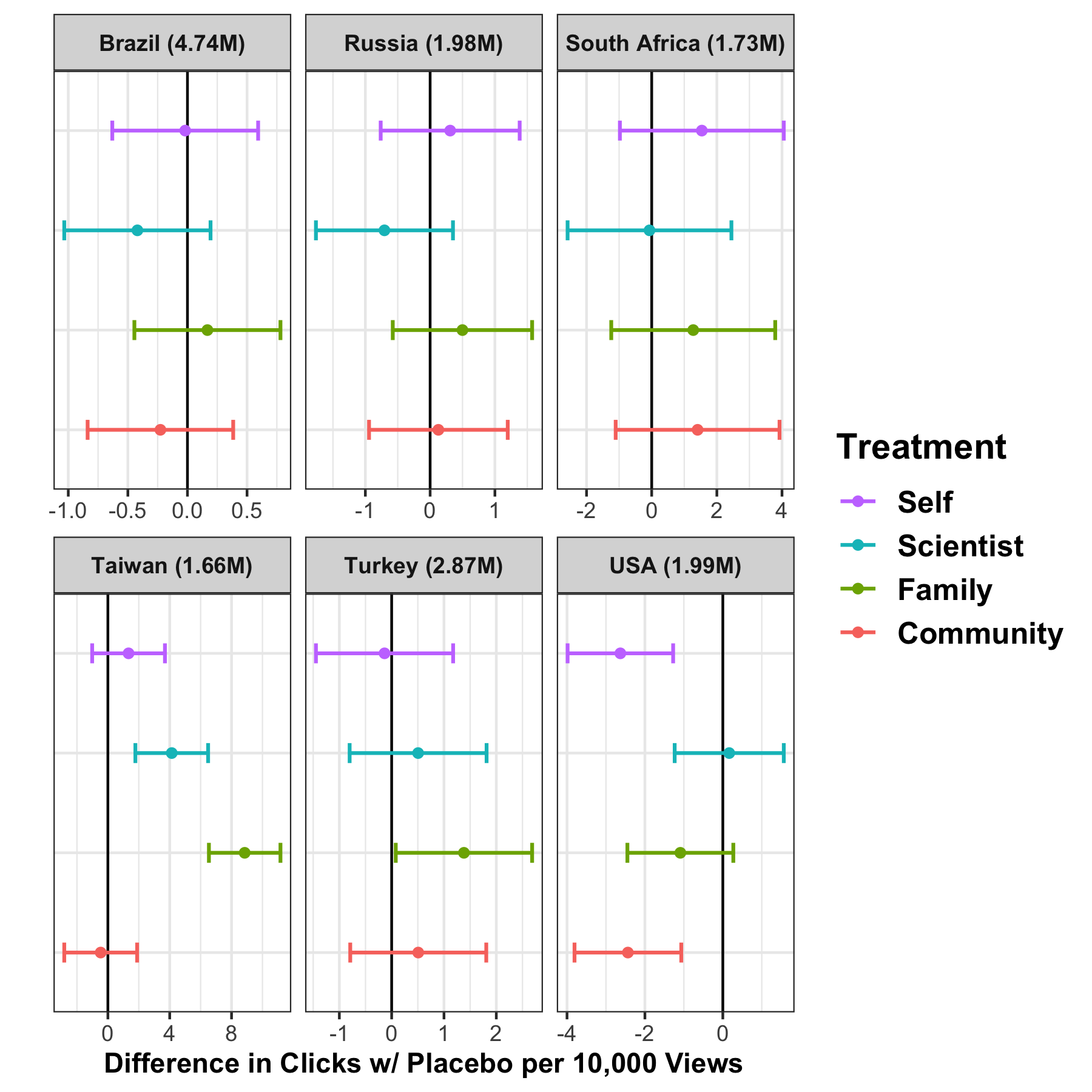
Behavioral nudges in Facebook ads reached nearly 15 million people across six diverse countries and, consequently, many thousands took the step of navigating to governments’ vaccine signup sites. However, none of the treatment ads caused significantly more vaccine signup intent than placebo uniformly across all countries. Critically, reporting the descriptive norm that 87% of people worldwide had either been vaccinated or planned vaccination—social proof—did not meaningfully increase vaccine signup intent in any country and significantly backfired in Taiwan. This result contradicts prominent prior findings. A charge to “protect lives in your family” significantly outperformed placebo in Taiwan and Turkey but saw null effects elsewhere. A message noting that vaccination significantly reduces hospitalization risk decreased signup intent in Brazil and had no significant effects in any other country. Such heterogeneity was the hallmark of the study: some messages saw significant treatment effects in some countries but failed in others. No nudge outperformed the placebo in Russia, a location of high vaccine skepticism. In all, widely touted behavioral nudges often failed to promote vaccine signup intent and appear to be moderated by cultural context.

Review of International Organizations 2023, with Terrence Chapman
Can IOs influence attitudes about regulating Big Tech?
Review of International Organizations, with Terrence Chapman

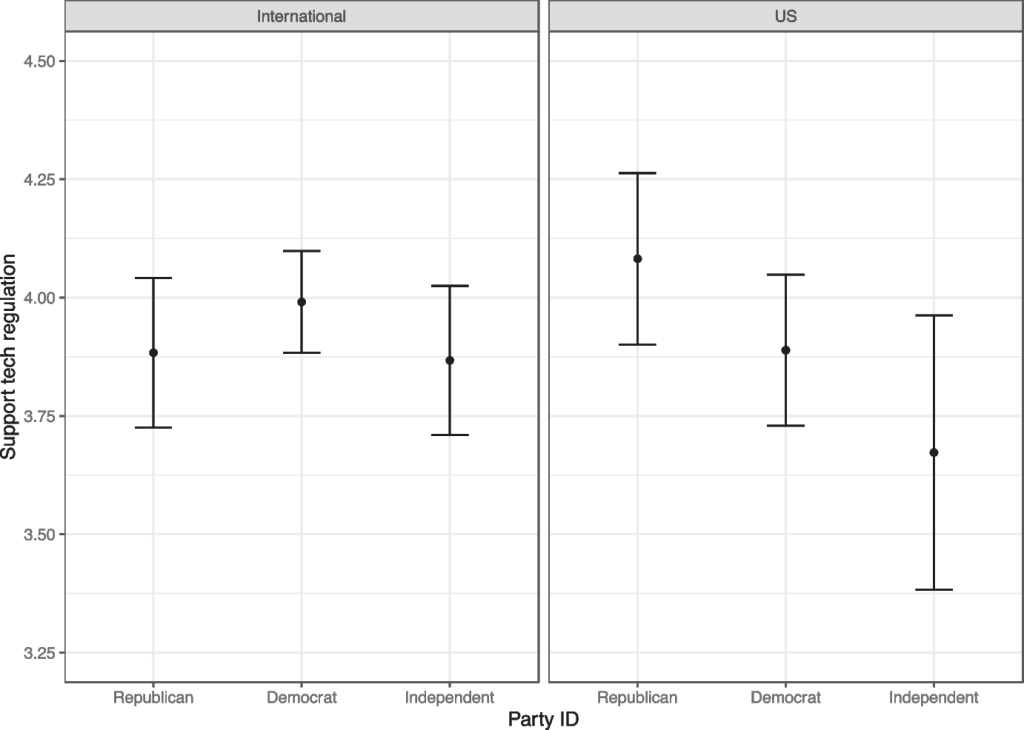
Can international organizations (IOs) influence attitudes about regulating “Big Tech?” Recent tech sector activity engenders multiple concerns, including the appropriate use of user data and monopolistic business practices. IOs have entered the debate, advocating for increased regulations to protect digital privacy and often framing the issue as a threat to fundamental human rights. Does this advocacy matter? We hypothesize individuals that score high on measures of internationalism will respond positively to calls for increased regulation that come from IOs and INGOs. We further predict Liberals and Democrats will be more receptive to IO and NGO messaging, especially when it emphasizes human rights, while Conservatives and Republicans will be more receptive to messaging from domestic institutions that emphasize antitrust actions. To assess these arguments, we fielded a nationally-representative survey experiment in the U.S. in July 2021 that varied the source and framing of a message about the dangers posed by tech firms, then asked respondents about support for increased regulation. The average treatment effect of international sources is largest for respondents who score high on an index of internationalism and for respondents on the left of the political spectrum. Contrary to expectations, we found few significant differences across human rights and anti-trust framings. Our results suggest the ability of IOs to influence attitudes about tech regulation may be limited in an era of polarization, but that individuals who value multilateralism may still be influenced by IO campaigns.

In Progress


Diffusing AI norms and policies: The role of IOs and epistemic communities

Policymakers face information gaps when regulating highly technical and rapidly evolving domains. In the context of artificial intelligence (AI), firms often possess greater knowledge and prioritize profits over placing guardrails on AI technologies. How do governments seek information to promote AI ethics and human rights? I argue that international organizations (IOs) and epistemic communities serve as alternative channels of information, facilitating the spread of normative principles and policy templates. Drawing on the OECD dataset of 70 countries, I hand-coded several policy outcomes related to ethics and rights protection, including ethical principles, data governance, algorithmic fairness, and guidelines for government use of AI. Statistical analysis includes matching and a difference-in-differences design. I find that countries with broader membership in IOs are more likely to emphasize ethical and human rights norms in their AI policy documents. Moreover, prior engagement with IO epistemic communities is associated with greater policy adoption, particularly among countries with higher government capacity. This paper underscores the increasing significance of international expertise in helping countries navigate AI’s disruptive consequences. 

A typology of AI governance: Regulating actors through formal and informal rules

As AI policies addressing ethics and human rights proliferate globally, the absence of clear conceptual and analytical frameworks makes it difficult to understand this complex phenomenon. How do countries regulate AI differently? Why do they regulate different actors in different ways? This paper proposes a typology of AI governance along two key dimensions: the targets of regulation (primarily private firms and government agencies) and the legal status (formal versus informal governance). Countries vary significantly across these dimensions, both in their regulatory priorities and the mechanisms they employ. I argue that countries with strong high-tech sectors are more likely to adopt informal governance, while regime type is central in determining whether countries regulate government use of AI. Drawing on the OECD dataset of national AI policies, I hand-coded attributes capturing combinations of regulatory targets and legal status to operationalize the outcomes of interest. The analysis shows that AI capacity is the strongest predictor of the adoption of informal rules, particularly with respect to firms. Regime type, specifically freedom of expression, is significantly associated with the regulation of government use of AI. This paper offers a novel theoretical framework and new empirical evidence on cross-national variation in AI governance, contributing to the debates on regulatory forms and priorities.

Mapping text similarity and AI regulation networks worldwide

AI presents enormous opportunities but also poses significant risks. In response, national governments and multilateral organizations have adopted a range of laws, regulations, and initiatives to address concerns related to AI. What explains the explosive growth of AI policies regarding ethics and human rights? Why do some countries align while others diverge in their policy objectives? This chapter examines both the timing of AI policy adoption and the similarity of language used in national initiatives. I argue that shared IO memberships and AI adoption rates are associated with greater convergence in policy language. To analyze these patterns, I leverage AI policy objectives as indicators of regulatory priorities and apply a keyword-based approach using the OECD dataset of nearly 900 national policies. Through topic modeling and network analysis, I capture descriptive trends distinguishing social protection from economic objectives. I also conduct dyadic regression analyses on the frequency of specific keywords within the ethics and human rights category — namely, ethics, privacy, non-discrimination, transparency, accountability, and safety. The findings suggest that AI ethical and human rights norms have diffused globally within a short period. Regarding the correlates of specific keywords, shared IO membership and the use of AI in law enforcement consistently correlate with greater textual similarity across all categories. This chapter maps the evolving landscape of AI governance through policy language, offering a detailed account of the mechanisms behind policy diffusion and policy alignment across countries.

Public opinion and emerging technologies

Designed to bind: business manager preferences for mandatory global governance of artificial intelligence

With Terrence Chapman and Daniel Nielson. Under review

Effective governance of artificial intelligence (AI) may ultimately require binding international rules, yet the political economy literature predicts that business interests—the sector most directly affected by any such regime—will resist mandatory regulation. This expectation guided our primary pre-registered hypothesis. To test it, we designed and fielded a conjoint experiment targeting firm managers and executives in four countries: the U.S., the U.K., France, and Germany. The experiment varied key attributes of hypothetical transnational AI regulation, including membership, scope, targeted actors, depth of obligation, and size of bureaucracy, while also randomizing respondents’ exposure to specific AI concerns such as bias, privacy, labor displacement, and lack of algorithm transparency. The results contradict the pre-registered hypotheses: across countries, levels of concern about AI, and trade exposure, managers and executives prefer inclusive and binding international rules over narrower and voluntary alternatives. French respondents are a partial exception, showing less enthusiasm for mandatory obligations, which may reflect the prominent domestic backlash against the EU AI Act in France during our survey period. As a whole, and contrary to longstanding expectations from the political economy literature, managers and executives in the business sector show far more support for encompassing and obligatory AI governance than anticipated.

Being watched: what drives mass attitudes about AI surveillance?

With Nivedita Jhunjhunwala and Terrence Chapman. Under review

Governments increasingly make use of new surveillance technologies powered by artificial intelligence. These technologies, such as facial recognition and the collection of personal data, offer many benefits, but also generate multiple concerns prompting calls for scrutiny and new forms of regulation. Yet overregulation of new technology can stifle innovation, and advocates of surveillance argue the benefits to society far outweigh the dangers. To better understand how prominent concerns about the technology impact individuals’ preferences for government regulation, we conducted survey experiments in the United States and the United Kingdom — two countries where AI surveillance technology is very common yet with different political cultures, histories with surveillance, and geopolitical positions. We presented respondents with some simple background information about AI surveillance, then randomized paragraph-long primes summarizing concerns about the technology that have been raised by think tanks, interest groups, and the media. Our analysis finds that concerns that Chinese surveillance technology presents a national security threat are especially salient in the U.S., while concerns about targeted surveillance for public safety may spill over into more routine surveillance resonate in the U.K. We also identify partisan and cross-country differences with respect to regulatory preferences.

Algorithms and ideologies: understanding political attitudes in the tech sector

With Doeun Kim

Security and enforcement

Connected devices, divided world: trade, geopolitics, and the governance of IoT cybersecurity

With Leopoldo Biffi and Erica Owen. Under review

The Internet of Things (IoT) has reshaped the global economy, extending connectivity across industries, infrastructure, and daily life in ways that generate both enormous value and growing vulnerability to cyber threats. Yet international governance of IoT cybersecurity remains nascent and often fragmented. Why do we observe international cooperation in some contexts and fragmentation in others? We argue that two factors shape governance of IoT: industry cybersecurity risk and the geopolitical relationship between states. In low-risk sectors such as consumer IoT, regulatory political economy dynamics apply, and international standards bodies and the WTO provide institutional frameworks within which states can coordinate on common rules and contest divergent ones. In high-risk sectors like critical infrastructure, security concerns displace economic ones, and outcomes follow geopolitical lines: coordination among allies, deliberate fragmentation among adversaries. Drawing on original data on national cybersecurity policies and specific trade concerns raised at the WTO, we show that geopolitical coalitions have become the dominant organizing logic of regulatory cooperation in this domain. Allied pairs show stronger substantive alignment in high-risk sectors, while fragmentation concentrates along adversarial lines. Our findings contribute to research on the securitization of international political economy and speak to the conditional authority of international organizations, based on the risk levels of technology across different domains. As billions more devices come online, the question of how their security is governed has never been more consequential.

Policing “big tech”: how enforcement actions differ across Europe

As more countries begin to pass laws to regulate Big Tech, the outcomes of enforcement remain uncertain. Tech multinational corporations (MNCs) can weaponize their dominant position in the market and communications networks to gain greater negotiating power with host governments. As a result, they are likely to undermine a country’s regulatory capacity and shape enforcement outcomes in foreign jurisdictions. When do large tech companies successfully deter regulatory activities, and under what conditions do governments enforce rules and penalties? This project seeks to address these questions by compiling a new dataset on enforcement actions undertaken by governments targeting large tech firms in Europe. While EU member states are required to adhere to a common legal framework in areas such as data protection and antitrust, the implementation and enforcement of these laws is the responsibility of national authorities. Drawing on media coverage and official government press releases, I gather information on the reasons for violations, relevant legislation, the amount of fines, and other related details. The activities of tech MNCs, such as self-regulation and lobbying, can trigger diverse institutional responses. I argue that a shorter transposition period, which refers to how quickly a directive is adopted at the national level, as well as the availability of multiple legal tools, may empower regulators to take action and intervene in the market.

Teaching


Instructor

University of Texas at Austin

Global Governance, Summer 2023

Syllabus

Teaching Assistant

University of Texas at Austin

Science, Technology, and Politics, Spring 2024

– led 3-hour weekly discussion sections

Business and Society, Fall 2024

Problems of US Politics, Fall 2022 and Fall 2023

Human Rights and World Politics, Spring 2023

International Political Economy, Fall 2021

United States Foreign Policy, Spring 2021 and Spring 2022

Politics of International Trade, Fall 2020